Chapter One: Madison Wisconsin
As the calendar turned to January 1st, 2008, George W Bush was beginning his last full year in the White House. Tammy Baldwin was representing the 2nd District in the U.S. House of Representatives and the Mayor of Madison was Dave Cieslewicz. Wisconsin was a battleground in national elections, but Dane County, of which Madison resides, has been voting Democratic in local and national elections for several decades. Since 1932, Dane County voters have given the majority to the Democratic nominee in every election except for one Republican nominee. In 1952 and 1956, a slight majority pushed Dane County into Dwight Eisenhowers’ corner. Since 2000, the majority has been at least 70% for the Democratic nominee. Before 1932, Dane County was slightly more apt to vote for a Republican presidential nominee. Dane County gave the majority to William McKinley in 1896 and 1900. Teddy Roosevelt got the Dane County nod in 1904, while Taft received a majority in 1908. The other two Republican nominees to receive a majority in Dane County was William Harding in 1920 and Herbert Hoover in 1928. Not surprisely, Robert LaFollette received the majority in 1924 running under the Progressive Party banner.
Judge James Doty had a dream. After Wisconsin was formed out of the Michigan Territory, Doty believed he could make some money. He purchased land on the isthmus between what are now known as Lake Monona and Lake Mendota. He named this land Madison after recently deceased President James Madison. In 1837, it was only a paper city, but Doty persuaded the territorial legislature to make the Madison the capital of Wisconsin. Not only did Madison become the capitol of Wisconsin, but it also was chosen as the location for the University of Wisconsin. This solidified Madison’s role as an important center for education and government. It incorporated as a village in 1846 and as a city in 1856.
Madison living souls numbered 232,447 in 2008. Suburbs included Middleton, Sun Prairie, Fitchburg, Monona, and the Town of Madison According to statistics, in 2008, 69% of the city’s population were white, 10% were of Hispanic descent, 8% were of Asian descent, and 7% were African-Americans. The biggest employers in Madison for 2008 were University of Wisconsin, State of Wisconsin, Epic Medical Software, Oscar Mayer, American Family Insurance, Sub-Zero, and the City of Madison. Madison was served with three hospitals. They were Meriter, St. Mary’s and UW Hospital. During sessions, UW Madison added about 46,000 students living in the city. Before the 1980’s, Madison was served with two main daily newspapers, the Wisconsin State Journal, and the Capitol Times. The WSJ was always considered to be the more conservative of the two. However, they have essentially merged, and both are now considered to be liberal-leaning papers. A weekly newsprint is called ‘The Isthmus’, and it is even more liberal-leaning than the daily newspapers.
In 2008, the Madison Police Department had an authorized commission staff strength of four-hundred and thirty-eight personnel. The police chief was Noble Wray and there were two assistant chiefs directly underneath the chief. The violent crime rate in Madison is significantly lower than the national average. Madison has always been considered to be a safer city than other cities similar in size and popuation. According to FBI statistics and Madison Police Department annual reports, the number of homides before 2008 were always below 10 per year. From 2000 until 2006, the highest number of homicides in one year in Madison was six. In 2007, that number jumped to 7. Quiet Madison however would be rocked by the highest number of homicides in 2008. There were ten confirmed homicides in 2008! Chicago had five murders on January 1st of that year and a total of 508 murders for the entire year.
The Mission Statement of the Madison Police Department in 2008 was:
We, the members of the Madison Police Department, are committed to providing high
quality police services that are accessible to all members of the community. We believe
in the dignity of all people and respect individual and constitutional rights in fulfilling this
mission.
Madison’s start to their record of homicides in 2008 would start on a warm (for Madison Wisconsin) January day. It would lead to intense public scrutiny and even be featured on a national television show. Out of the sixty-four detectives working for MPD in 2008, one detective would be tasked as the lead detective. This detective was me.
Chapter Two: What A Great Day for Getting Outside
Chapter Three: He's Just Laying In the Snow
Wisconsin Dane County 911 Center: “911, What’s the address of the emergency?” 1
The 911 female call taker was calm but decisive when answering this 911 call on Monday, January 28th, 2008, at 1:22PM. Since the weather on this January day was exceptionally warm for Madison Wisconsin, the 911 call-takers were expecting a busy day. It was sunny and 44 degrees when the call-taker took this call. As of 2025, this is the second warmest January 28th on record and was only topped back in 1914. Seventeen degrees above the normal high of 27 degrees caused Madisonians to take advantage by enjoying long lunch breaks outside. Heck, it had only been about ten days previously on January 19th, when the high temperature was minus 2 and a low of minus 12. Not only that, but the forecast was also calling for falling temperatures the following day. By January 30th, the high would be a whopping four degrees and the low would be minus eight.
Lindsey Kaun: “Um, there’s a man unconscious in the alley. My boss just found him.” (call location showed up in the 911 call as 707 S Park Street in Madison)
911: “Okay, stay on the phone with me.”
Lindsey Kaun: “Okay, she’s going outside, I think there’s another person helping him right now”. (Brandon Shearier) “But I think we need……..he’s just laying in the snow. Right by Saint Mary’s.”
911: “Are you with the person now?”
Lindsey: “No, but I can go over there if you want me to?”
911: “How close are you?”
Lindsey: “I’m right outside of work, my boss is right by the man.”
911: “About how old is this man?”
Lindsey: “He looks like an older man.” (Lindsey can be heard asking “How old is he?”), “I don’t know, he’s purple.”
911: “Okay, about how old is he maam?”
Lindsey: (Lindsey can be heard asking, “You think he’s 25?”) “Yea, about 20.”
911: “Okay, is he conscious?”
Lindsey: “I don’t think so.”
911: “Is he breathing?”
Lindsey: (Lindsey can be heard asking, “Is he breathing?”), “I don’t think so.”
911: “Stay on the phone with me.”
Lindsey: “It looks like he took a tumble. His glasses are off and there’s blood all over. Ya, it’s right in the alleyway. He’s down in the snow.”
911: “Okay, we have an ambulance and the police on the way. Stay on the phone with me. Did you see what happened at all?”
Lindsey: “No, we didn’t. I don’t think he’s okay.”
911: “Okay, we have help coming. Is there a defibrillator available? An AED”
Lindsey: “An AED?”
911: “That will shock the body. Is there one available?”
Lindsey: “No”
911: “Sending the paramedics now. If you stay on the line, I’ll tell you what to do next.” “Listen carefully. We need to lay him flat on his back on the ground with nothing underneath his head and I want you to kneel next to him and look in his mouth for any food or vomit.”
Lindsey: “Okay, there’s a lot of blood.” “Blood all over, he’s just laying here. Ooh, there’s a lot of blood. Ooh, it looks like he’s really hurt. Ooh”
911: “You said, he looks purple?”
Lindsey: “He’s very, very limp, very purple, lots of blood. His eyes are, are very not blinking. His eyes aren’t blinking.” (Other voices are heard in the background)
911: “Is anything in his mouth? Any food or vomit?”
Lindsey: “It’s all, um, it looks like his spit and rocks, like he just laid”
911: “In his mouth though?”
Lindsey: “I don’t see anything.”
As the call-taker explains how to perform CPR, Lindsey can be heard telling the others at the scene “He’s really bloody.” Lindsey’s boss can be heard in the background stating, “We don’t have any gloves. You need to wipe off your hands.”
Yvette Jones is the owner of Design Craft located at 707 S Park Street. This business fronts the alley which is being referred to during this call. She is Lindsey’s “boss”.
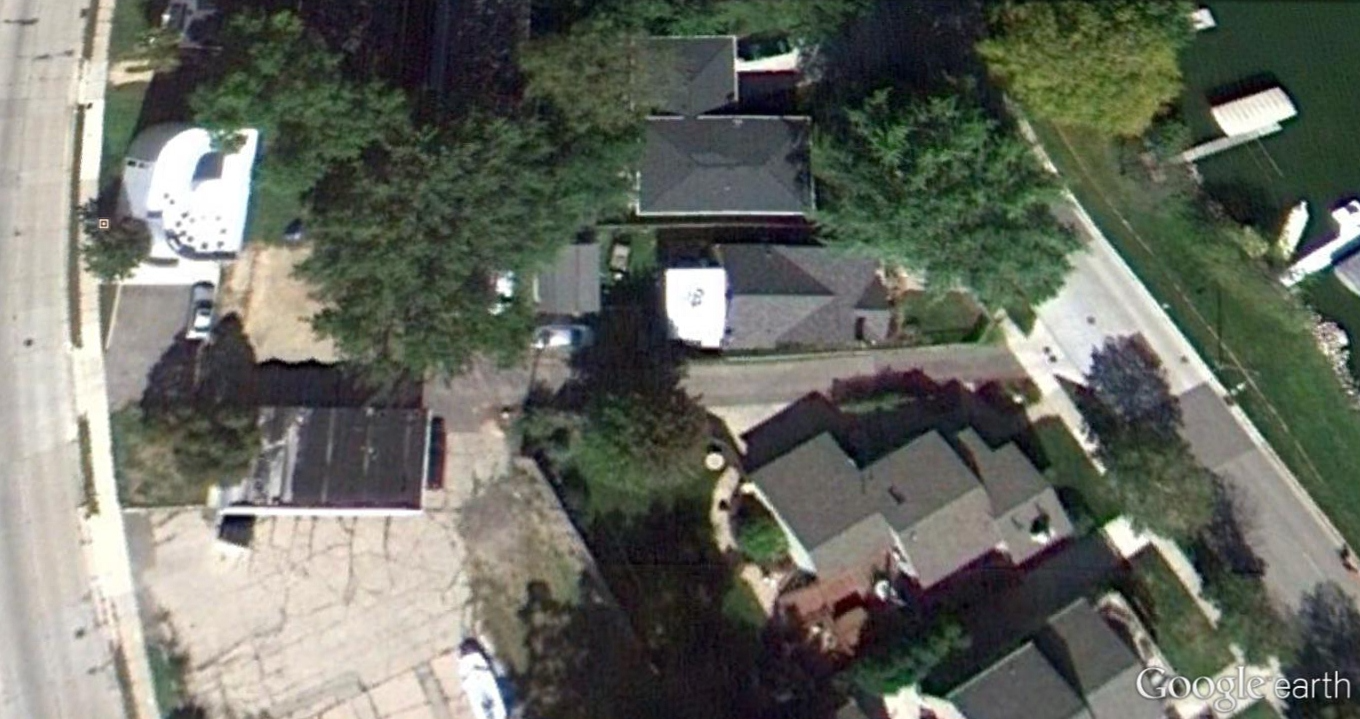
The alley is one short block long, running from S Park Street to West Shore Drive. West Shore Drives runs along Monona Bay which is an inlet from Lake Monona. Design Craft is the white building to the left in the picture below. The alley is below the white building and runs from left to right. The Street on the far left is S Park Street while the parallel street to the right is West Shore Drive. Monona Bay can be seen on the extreme right of the image.
Yvette: “Um, when we, when she tried to do a compression, there was more blood coming out. He seems to have some wound in his chest or something.”
911: “Okay, we’re going to try to pump the chest hard and fast.” Sirens are now heard three minutes and 26 seconds into the call.
Yvette: “But there’s blood coming out, do you care?” “Okay the firetruck is here.”
Throughout 911 Communication Centers in the United States, emergency calls are constantly being handled by professionally trained staff. When these recorded 911 calls are released to the public and placed on social media sites such as YouTube, the call-takers are subject to intense scrutiny by the public. Based on many comments read by this author, a percentage of the public doesn’t have the information to make informed critical statements about how the 911 call was handled by the center. Many are enraged at the call-taker for asking too many questions and not getting first responders dispatched to the emergency. In most locations, the call-takers are not the person dispatching the first responders. When an emergency needs to be dispatched immediately such as the above call in Madison, the call-taker will work with a dispatcher to start the first responders rolling to the emergency. However, the more information, the first responders have, the better they will be prepared to handle the emergency. In addition, witnesses tend to disappear so getting as much information about them is important, especially when the “witness” or caller turns out to be the suspect in a crime. Even when an emergency sounds like a medical issue, the police are normally dispatched in the event, the medical emergency turns out to be a potential criminal investigation. The fire department personnel can always call off the police if they decide the police aren’t needed.
In the Madison 911 call center, a man down in an alley without any known explanation, is cause for the both the police and fire personnel to be dispatched to the emergency. Madison Fire Truck #4 arrived on the scene about three minutes after the call came. Arriving shortly afterwards was Rescue One driven by Madison Fire Department (MFD) Paramedic Terry Ritter. Ritter was informed by one of the firefighters, that the victim appeared to have multiple stab wounds to his chest. Ritter he was unable to find further wounds to the male subject after they rolled the victim from his back to his side to check for exit wounds or back injuries.
As Police Officer Scott Favour arrived on the scene, the victim was placed on a backboard and placed into the ambulance. While two firefighters performed chest compressions, Ritter started an inner osseous line in the victim’s left shin which delivered saline and then epinephrine. Another paramedic started a second line in the victim’s left external jugular. Knowing the victim was in a high level of distress, the ambulance raced off to University of Wisconsin Hospital. This is the only Madison hospital with a Level One Trauma Center as some questioned why he wasn’t taken across the street to St Mary’s Hospital.
While the male victim was being transported to UW hospital, other police personnel started arriving on the scene. Sergeant Chris Paulson quickly established a large crime scene perimeter and started to assign incoming officers to crime scene security. It was apparent to all now that this man had not suffered a medical emergency but had instead been the recipient of a violent encounter. While the victim fought for his life, the police had started a criminal investigation. The scene was quickly secured, but where were the detectives and forensic investigators? Plus, who was this male victim and what had happened to him where he was found face-down in a small alley. This was a quiet neighborhood with very little crime in the immediate neighborhood.
 Our Italian Adventure