I have to confess that I have an unsophisticated palate. By definition, this means I’m not able to discern subtle flavors or appreciate the nuances of different wines. During wine tastings, I’m not the person who impressively states, “The grape has a subtle smell of honeysuckle floral with a hint of black currant. I can tell the aging process has produced a hazelnut flavor to this wine.” No, my response would be limited to, ” I like it” or “It’s too dry for me.”. Despite my limitations, I love wine-tasting events. Amy has more sophistication than I do, but not to the level of a wine connoisseur. When the day started, Amy believed she wasn’t a fan of Chianti wines.
On Sunday, May 16th, we traversed over the hilly paths to San Domenico Church where we would meet our fellow wine-tasting associates and our TuscanEscapes driver. As we walked toward the church, something below us caught our attention. It turned out that Siena has built escalators in several locations around the city to help walkers navigate through the hills. Upon returning to Siena from our tour, we took the five separate escalators up the hill to a location near our VRBO. Drat, how come it only took us 4 days to discover these hill shortcuts?
At the church, we met Uti & Michael who were from Germany. I was stationed in Wurzburg Germany during my army years and Uti actually worked with the United States Army helping to indoctrinate new soldiers arriving in Germany. Michael was a developer with a tech company. I have a basic foundation with the German language, but both of them spoke English without difficulty. I would estimate their ages to be in their early 50’s. Hillary & Alan were from Georgia and were probably in their late 30’s to early 40’s. The other couple was from England. They were friendly, but somewhat reserved in our outgoing group. Our driver was newer to the company and loosened up quite a bit after his long, dry spiel about our itinerary.
As we drove into the Tuscany Chianti hills rich with oak forests and cypress trees, the endless sight of vineyards and olive trees began. Our first stop would be the famous Castillo di Brolio estate on the Castle Road. This 12th century fortification had been bombarded several times during warfare between Siena and Florence. It has become a wine destination since Baron Bettino Ricasoli perfected the Chianti recipe in the mid-1800’s. The Baron had been a close advisor to King Victor Emmanuel II and also served as Italy’s Prime Minister on two occasions. The Chianti Classico he founded was called ‘Gall Nero’. The original Chianti recipe was 70% Sangiovese (for bouquet & strength); 15% Canaiolo (for softness); and 15% Malvasio Bianca (white grape for aroma & balance. This recipe was eventually changed to the standards used today. The requirement is now 80% Sangiovese, no white grapes, and a minimum of 12.9%ABV. Sangiovese is Italy’s most important red grape. The Classical Chianti is known for its medium to full body taste with a high acidity content making it great to pair with food. During WW2, retreating German troops hid out at the castle in July of 1944. The castle came under Allied bombardment for twelve straight days before the Allies took over. The castle was not destroyed, but the pockmarks of shrapnel are visible yet. The Nazi officer-in-charge disclosed after the war that he had been ordered to blow up the castle and he had refused to do so. He was convicted by a Nazi court and only released after the war ended. We walked around the lovely grounds and enjoyed some views from the castle walls before heading off to the Brolio wine shop at the base of the hill. Our first wine tasting occurred here, and we purchased a bottle of a 2022 Brolio-Bettino. What about the Black Rooster? Not yet.

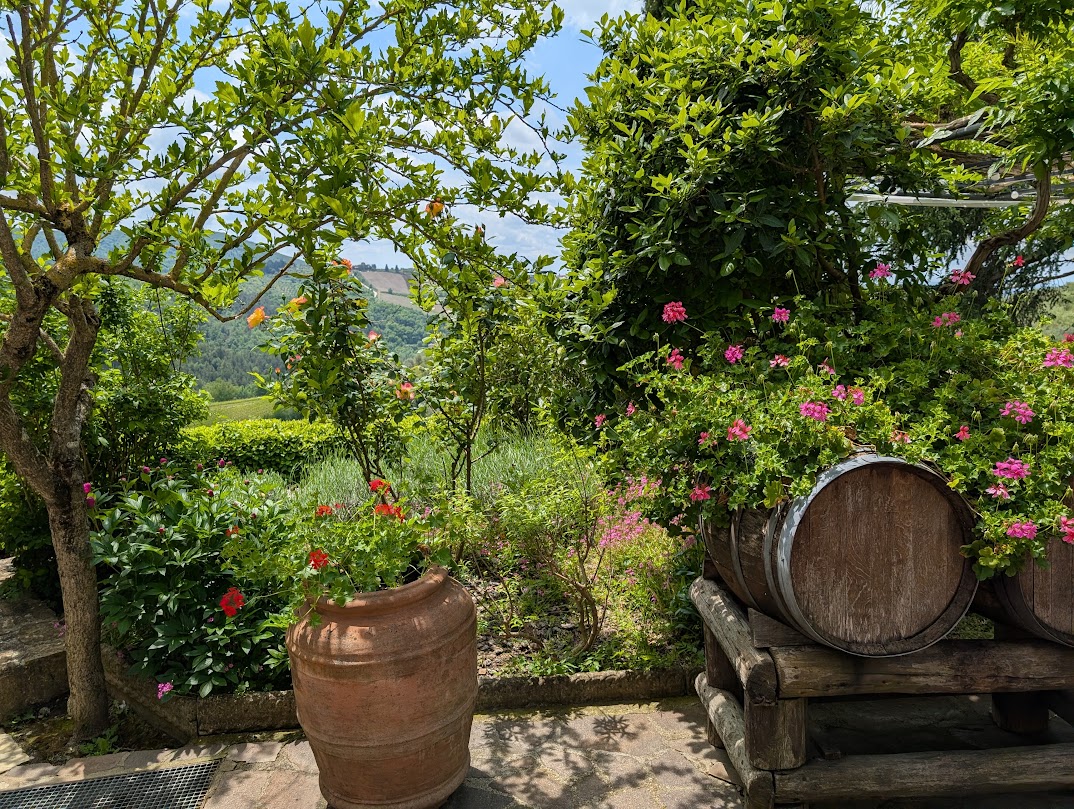
We drove further into the Tuscany hills and made our second stop almost exactly halfway between Siena & Florence. This was the Casanova di Bricciano estate owned by the Rossi family since the 1950’s. The winery is located in Gailole in Chianti. We had a tour of the grounds including the wine that was produced and placed into aging barrels. . Afterwards, we were treated to a wine tasting with food pairings. Four Chianti styled wines were paired with jams, cheeses, salami, breads, bruschetta, honey, and olive oils. It was at this stop that we started to understand the Black Rooster history.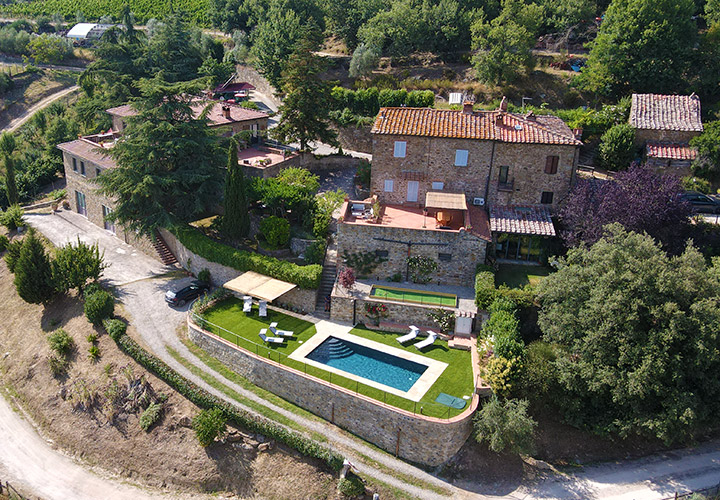
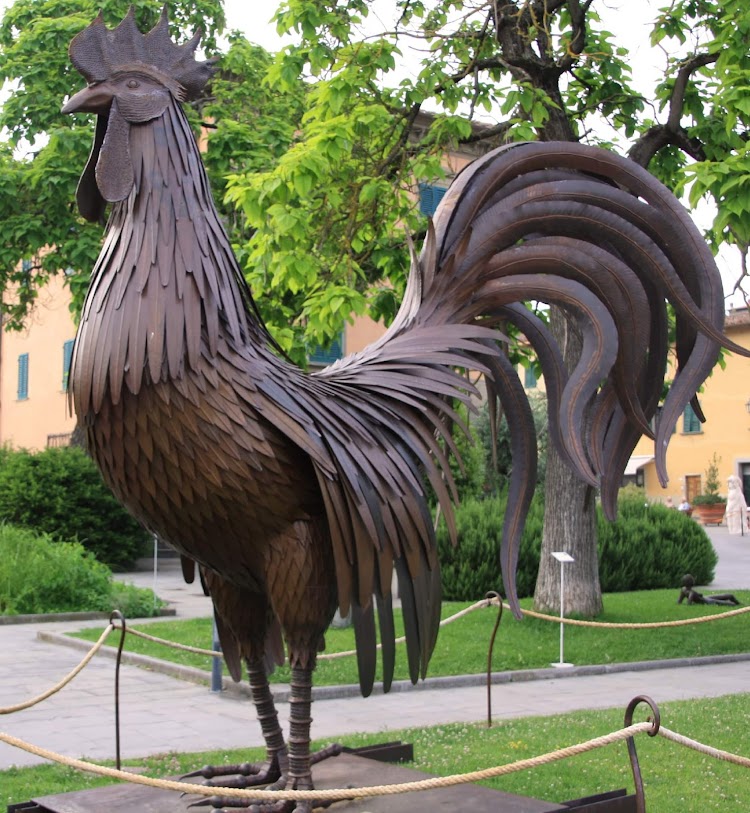
The Black Rooster is the trademark of ‘Chianti Classico’ which is produced in the historic heartland between Florence and Siena. Only wines made in this zone qualify for the rooster logo. According to legend, Florence and Siena disputed what the Chianti boundaries were for each city. They agreed to have these lands defined by sending out a knight as soon as the rooster would crow at dawn from each city. The spot where the knights would meet would be the location from which both cities could claim the Chianti lands. Florence secretly kept a hungry black rooster for the morning in question. This rooster crowed before dawn, thus giving the Florence knight a head start in their quest for Chianti land. The Knights met at Fonterutoli/Castellina which gave the Florentines more Chianti land than Siena.

Our final wine-tasting would occur in Castellina in Chianti at the Setriolo estate. Juan & Mariana uprooted their family to move from Argentina to Tuscany in search of owning a winery. They purchased the Setriolo estate in 2004 and have been producing fine wine since. Juan was our host as we tasted several more wines with some food pairings. Juan took our group out to the vineyards, where he explained that picking season would be in September/October, so the vines were bare of grapes in May. What we learned from this stop was that most of the European wines have an American rootstalk foundation.
Around 1853, the Phylloxera crisis started with the accidental import of the Phylloxera insect from North America. This insect is like an aphid, and it attacks the roots of the grapevines. The crisis started in southern France, but within twenty years had spread to most of Europe, including Italy. At its peak in the late 1800’s, the crisis had destroyed 70% of the vineyards. It was discovered that most of the European grape varieties had no natural defense against the bug. The good news, however, was that North American vineyards were resistant to the bug. Eventually, the European vineyards were brought back to life by grafting the European vines onto the resistant American rootstocks. This practice is still used today.


Left Front to Clockwise: Hillary, English wife, Amy, Matt, Juan, English husband, Alan, Michael, Uta.
With everyone except our tour guide, somewhat tipsy from elegant Italian wine, we drove back to Siena. Thankfully, we had discovered those escalators, or we might have slept by the church! Plus, Chianti wines had two new fans. As a final bonus for our enjoyable day, we ran into Mike & Uta on the way to dinner. They just happened to be going to the same restaurant as we had a reservation for. While they didn’t have a reservation, the restaurant allowed us to enlarge our reservation by two. We had a very nice evening with Michael & Uta.
 Our Italian Adventure
Leave a comment