We started our morning by paying tribute to our Contrada Rhino. We hoped it would bless us with a good day of touring Siena on Saturday, May 17th. A great start as the sun was reflecting on the hills surrounding Siena resulting in comfortable temperatures. Like Rome, Siena has an interesting legend concerning its beginning. After Romulus killed his brother Remus over the disagreement where Rome should be built, legend has it that Remus’ two sons, Senius & Aschius fled Rome on horseback. One brother rode a black horse and the other escaped on white steed. The legend claims they also stole the Capitoline Hill she-wolf during their escape. On their way north, they were reportedly protected by a white cloud during the day, and a black cloud during the night. These brothers founded Siena whose official colors are white and black.
The first link to the legend above is the imposing and beautiful Siena Duomo. The exterior is clad in black & white marble. While having an unique and beautiful exterior, the interior is even more impressive. This large complex includes a crypt, baptistery, library, and the Gates of Heaven. Most impressive are those who provided the statues adorning the interior. The big three of Roman sculpting: Donatello, Michelangelo, and Bernini. This illustrates the power and prestige that Siena had in the middle ages. The lantern on top of the dome was designed by Bernini and the interior adornments matches those of any other famous Roman churches. We had purchased the Gates of Heaven pass which gave us priority entrance not only into the church, but also allowed access to the roof and terraces for panoramic views of the church and Siena. The Black Death epidemic of 1348 wiped out one-half of Siena’s population. As a result, Siena’s power diminished in the region. However, the medieval buildings are intact as only the rail lines were bombed during WW2. The so-called stolen she-wolf from Rome is on display in the town hall known as the Palazzo Pubblica which is located in Piazza del Campo.


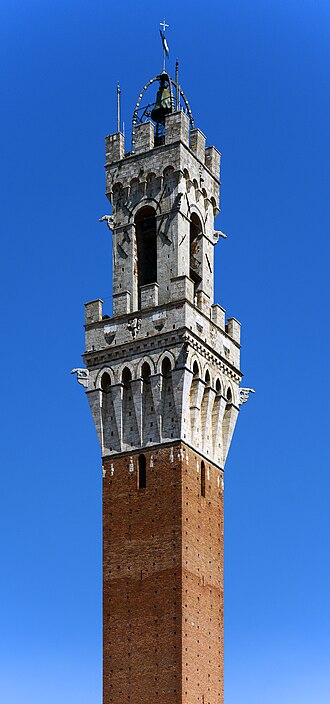
While revisiting Piazza del Campo, we enjoyed some laid-back people watching while indulging ourselves in overpriced beverages. Ah, the well-known fact that you’ll have to pay more when people watching in Italian piazzas. Another fun fact about Italy are their towers. Torres aka towers were built in Italy during the 12th & 13th centuries. They were most popular in the Tuscany region. These medieval towers were built by patrician families to display their power and prestige to others. Of course, this turned into “better than the Jones” scenario. Each wealthy family would then build their tower higher than their neighbor in a game of one-upmanship. Over time, a majority of the towers have been demolished. The town with the most surviving towers is, nope, we’ll save that for tomorrow’s blog since we’ll be in that town. Of course, the most famous tower is the Leaning Tower of Pisa. Another example would be in Bologna. Of the original 180 towers which were built, only 22 towers survive today.
Siena’s tower is called Torre del Mangia. It was built around 1338 to serve as a bell tower for their town hall aka Palazzo Pubblica. It was named after the first bellringer whose shortened nickname was Mangia. He apparently spent all of his earnings on food as mangia means ‘eater’ in Italian. The tower was built to the same height as the Duomo to show the balance between church & the state was equal. Mangia is the second tallest tower in Italy. We climbed the 400 grueling steps to the top and were rewarded with great views of the city.
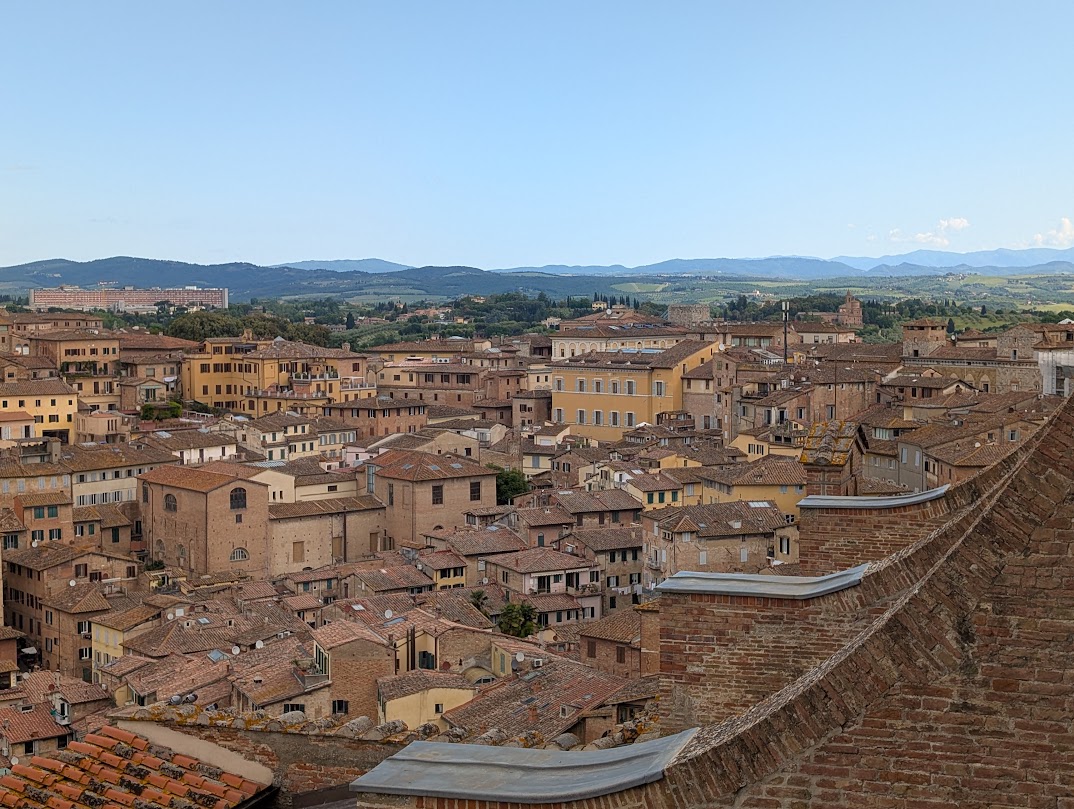
Siena is a very hilly city. Up and down hills we went all day. Some paths weren’t very easy to walk on, and many others were cobblestone. If you’re not very mobile, this town may not be the best choice to visit. Because of how the streets are configured and restricted with traffic zones, taking a taxi from A to B will take longer than walking. Plus, many parts of the historic town has prohibited zones for tourists to drive in. On our way to dinner, Amy was flagged down by two women in a rental car. They were completely lost and were now in a prohibited zone. Since we didn’t have a car, we couldn’t help them with directions. We still wonder if they ever got out. What we also found in these towns with narrow streets and taller buildings, is that Google Maps has a hard time. Many times, GM would send us in the wrong direction. Because of the hills and faulty directions, we had worked up quite the appetite for lunch and went off to find Gino Cacino di Angelo. It wasn’t the easiest place to find as it’s off the beaten path aka it’s not in a tourist area.
With weary legs and hungry bellies, we finally located the small shoppe in the same square as the old market place. We followed a large college-aged group in and while looking at the various menus of sandwiches, we were told by the owner that it would be awhile and that we should sit down and wait. No problem as there was a beer cooler. We chose our beers, and waited patiently. The customers were all locals, and you could tell this was not an establishment which catered to tourists. Eventually, he motioned for us to place our order. We did so and watched this artist go to work. It was very refreshing to find an food artisan who truly enjoyed his craft. After the process was completed, we returned to our table with savory-looking sandwiches. We took our first bites and were instantly in heaven. Without a doubt, this was the best sandwich/panini I’ve ever had. Before leaving, I wrote a five-star review and ended it by stating “A business popular with locals is always better than one popular with tourists.” The owner replied with a very nice note back in the reviews, “Thank you so much Matthew. Your words reassure me and gratify me. And this is very important for those who do this work, and in general for all the people who work. The recognition of the effort put in is much more important than money.” I was glad to have complimented his craft, because several days before, a tourist had written a bad review complaining about having to wait and said the owner was rude.” I just wanted to reassure him that not all tourists are jerks.
The walk to the San Domenico Basilica was another test of our hill-climbing ability. This church would have been our gathering point for both of our Tuscany tours, but Sunday’s meeting point became different because a bike race was occurring on Sunday in Siena. The roads leading to this church became part of the race route, thus closing it to vehicular traffic. San Domenico is not as aesthetically pleasing as the Duomo, but it sits atop one of Siena’s many hills. This setting gives it a majestic appearance. Besides, this church contains the relics of Saint Catherine. This remarkable woman lived from 1347 to 1380 and was made a saint in 1461 by Pope Pius. Generally, mankind had it rough in the middle ages, but women had it the worst. For the most part, women were expected to raise families, defer to men in most other matters, and not ruffle any feathers. Women who were deemed to be “troublemakers” might be tried as witches, or at best, ostracized by their community. Catherine was an exception. Not only did she care for the sick and incarcerated in Siena, but she became an exceptional writer who wrote about man’s duty to god. This resulted in getting the ear of the Papacy. She was sent to Rome several times to carry out missions on behalf of the Church. In addition, she advocated successfully for the Papacy to return to Rome from Avignon. In her last years, Catherine became involved in politics. Just two years before her death, she was sent to Florence to bring peace. Her successful mission brought peace to Siena with the Florentine Republic. She was probably one of the most powerful women in Italy during her lifetime. This power was very rare for a woman in the middle ages.


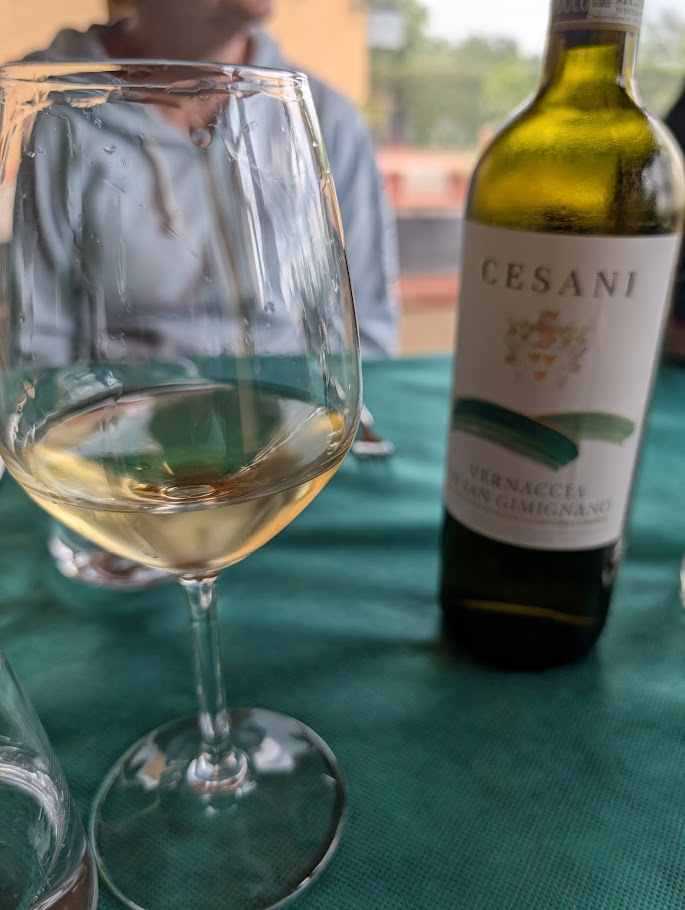
Our day in Siena ended with a fantastic dinner at the Osteria da Divo. They serve Tuscany styled dinners in a stunning medieval hall. An Osteria restaurant is normally run by a family. They are open during lunch and then again at 7pm for dinner. Their menus rotate depending on what produce they are able to obtain locally. They make everything from scratch, including the pasta. An Italian menu will consist of five courses. The antipastos are what we would call appetizers. The primi normally consist of pasta-based portions. The secondi or the main dishes are the meat or fish entrees. The Contorno are normally the side dishes such as veggies, salads, or potatoes. The final course is the Dolci which are the delicious Italian desserts. One can order as many or few of the courses as they desire. Of course, wine is on every menu. What better to have with an Italian dinner than a glass (or two) of classic Italian wine.

 Our Italian Adventure
Leave a comment