The Roman Empire was one of the most powerful and sucessful empires in the history of mankind. However, about 500 years after it started, the Western Roman Empire collapsed. What started with the reign of Augustus Caesar in 27BC, ended in 476AD. If the “American Experiment” lasts roughly the same time period, we only have about 250 years to go.
We started our morning at the Roman Colosseum with our first organized tour group. We paid for the “Gladiator Experience” with Get Your Guide. The tour would include the Colosseum, the Palatine Hill, and the Roman Forum. As Amy described it, “a lot of ruins.” This tour was done with the temperature around 74 degrees. We can’t believe how incredibly hot this tour must be in the heat of the summer. There is no shade in these areas.
In order to truly enjoy the Colosseum, one must be able to imagine the arena full with thousands of common Romans, the Senate and nobility along with the Emperor. Remember, there weren’t many options for entertainment. This was the entertainment and what a show they would put on. Exotic animals from the Asian and African continents were slaughtered. Christians, criminals, and captured slaves were also slaughtered. The highlight was always the trained and powerful Gladiators.
Fun Facts About the Colosseum: First, how were they able to feed the throngs of people as these shows lasted all day? The answer is simple. They fed everyone all of those slaughtered animals which had started the morning spectacle. The meat wouldn’t go to waste as they used it to feed the hungry spectators. Second, there were no sewer systems and the bathrooms consisted of a long trough for those needing to do their business. One would bend over the trough and do their business. Afterwards, they would use the community brush to wipe oneself. The water would run down the trough to areas below.
The Palatine Hill does contain many ruins. The ruins run the gamut of a single column to mostly intact building. What we learned early in our Rome stay was that when new buildings were needed, they would strip an existing building for the building parts. Our tour operator was hard to understand, so for those who didn’t become educated about the contents of Palatine Hill including the Roman Forum, this part of the tour was truly “a bunch of ruins”. I had studied the origins of many of the ruins and what they meant to the Romans back in those days. I thought about taking Amy around to more sites on the Palatine Hill to help both of us get a better understanding. When I looked at Amy, I could tell she was done looking at ruins, it was around lunchtime and we were both getting pretty warm. We left Palatine Hill and had our worst meal of the entire trip with completely undercooked pizza. 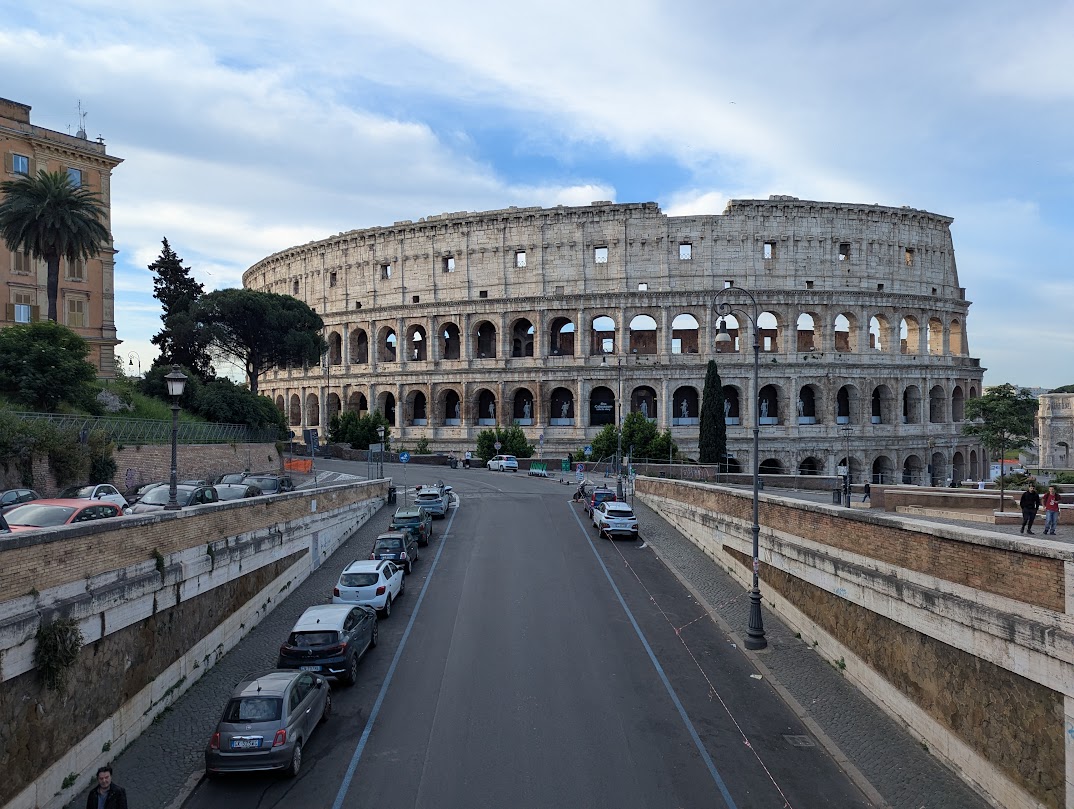
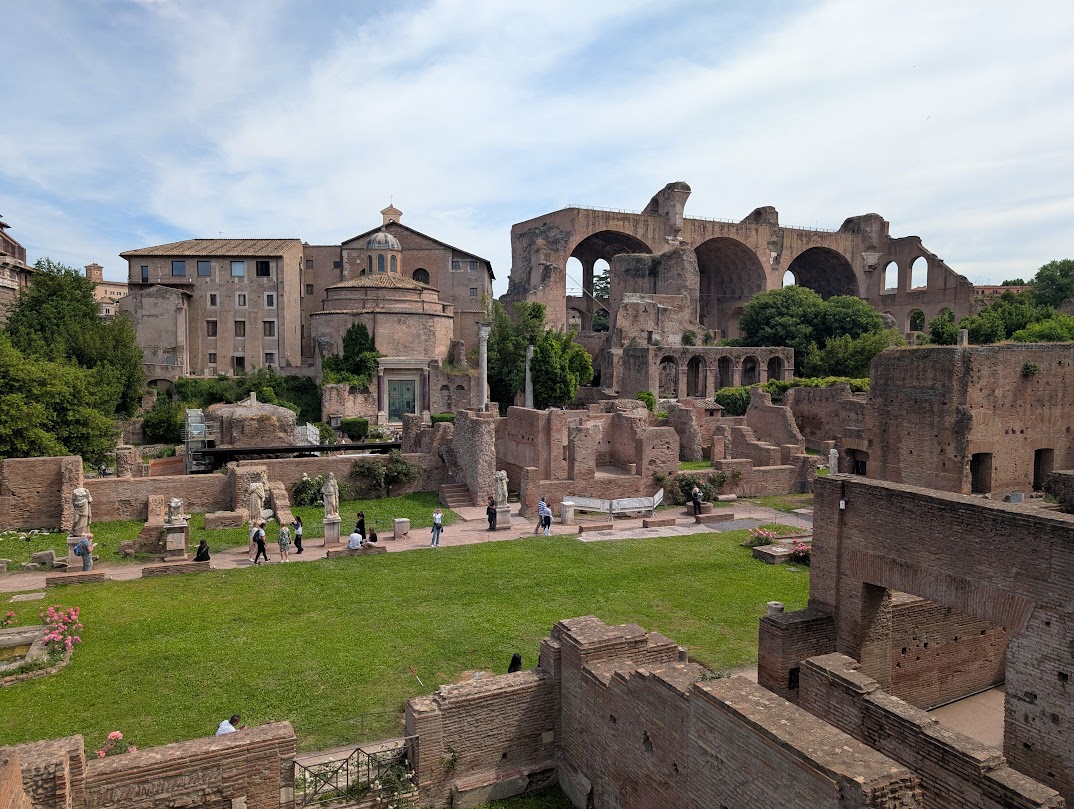
After lunch we checked out more ruins such as the Trajan Column & Forum, Foro di Augusto, and the Imperial Fora. After our tour was completed, it was on to other sites in historic Rome. In Cologne Germany, it would be impossible to not see the enormous Cologne Cathedral. In Rome, it would really be hard to miss the Victor Emmanuel Monument which is built on the Capitoline Hill. This monument was erected to honor Italy’s unification and their first king. This immense monument was also a great location to take the elevator to the upper terraces for great views of Palatine Hill and the Colosseum.
Next we climbed the Ara Coeli staircase which is behind Santa Maria Aracoeli Basilica. These stairs used to go all of the way down to the Roman Forum and were also known as the “Stairs of Mourning”. Criminals were executed at the top of the stairs and and then thrown down the stairs where their bodies were left to rot. 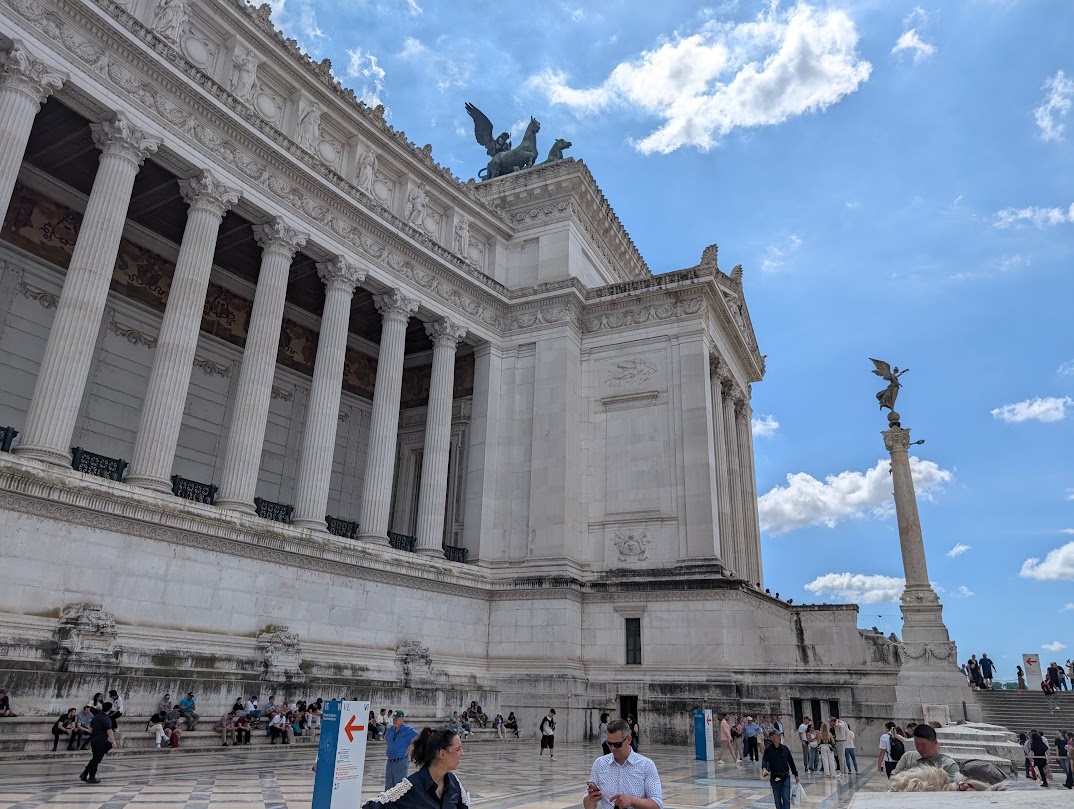
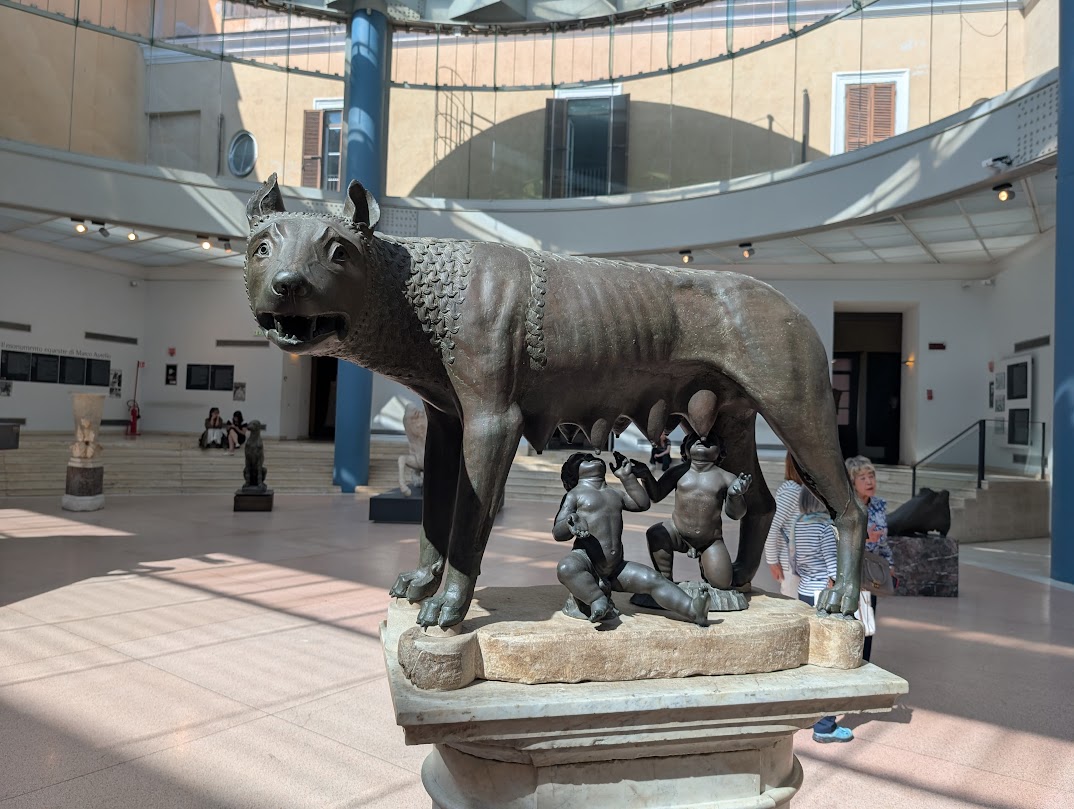
Another highlight of our Roman History day was visiting the Capitoline Museums. The Square and complex were conceived by Michelangelo in 1536. The museum can be traced back to 1471 when Pope Sixtus IV donated a collection of ancient Roman statues. It was opened to the public in 1734 making it one of the oldest museums in the world. It consisted of three main buildings. This museum contains the original “she-wolf” sculpture. For the uniformed, the history of Rome is traced to the legend of Romulus and Remus. They were abandoned and raised by the she-wolf. Another highlight of the museum is the colossal statue of Oceanus.
A fantastic Italian dinner at the Ristorante Pancrazio dal 1922 completed our Roman Empire day.
Fun Fact: Remus & Romulus couldn’t agree to where they should start building the city of Rome. In the end because of the disagreement, Romulus killed his brother. Thus, the city is known as Roma, not Remusa!
 Our Italian Adventure
Leave a comment